All posts filed under: Food Musings

Finding the Right Fish, Take Two

A few weeks ago I shared some tips on selecting eco-friendly, consumer-safe seafood. With the new year here and most of us thinking about, if not actually engaging in, healthful eating habits, I’ve decided to revisit the topic. My search for environmentally sound fish continues with barramundi, sablefish and Dungeness crab. Now raised in the U.S. in enclosed, re-circulating tanks, the hardy, fast-growing Australian barramundi qualifies as eco-safe seafood. High in omega-3 fatty acids, it likewise offers a heart-healthy option. Thanks to its sweet, succulent meat and edible, crisp-when-cooked skin, barramundi has become a favorite with cooks. A versatile fish, whole barramundi can be grilled, baked, roasted or steamed. Fillets are ideal for pan-frying, grilling, sautéing and broiling. Barramundi pairs nicely with a range of foods. It compliments arugula, bok choy, brown sugar, cilantro, garlic, limes, shallots and soy sauce, among others. While the overfished Atlantic cod tops the list of seafood to avoid, the abundant, long-lived “black cod” or sablefish falls firmly into the safe category. Caught wild in Alaska and British Columbia, this …
Champagne for Everyone!

It’s one of my favorite lines from the BBC series “Little Britain.” It’s also the phrase that I hear frequently during this holiday season. Champagne and New Year’s Eve go together like turkey and Thanksgiving, chocolate and Valentine’s Day, eggs and . . . well, you get the idea. Although many countries produce sparkling wines, only the Champagne region of northeast France creates the bubbly beverage known as champagne. This region has been crafting its eponymous libation since the 17th century. Unsurprisingly, the area is home to some of the oldest champagne houses including Taittinger, Veuve Clicquot and Moet and Chandon. Various legends surround the origins of the first champagne. Many point to the Benedictine monk and cellar master of the Abbey of Hautvillers, Dom Perignon, as its inventor. While Perignon did develop the techniques of blending wines to improve the flavor and of tying down corks with strings or wire cages to prevent popping or bottle breakage, he did not create champagne. Apparently, no one invented champagne. The drink’s trademark fizziness was merely a …

holiday cocktails

Holidays – Just Another Word for “Cocktails”

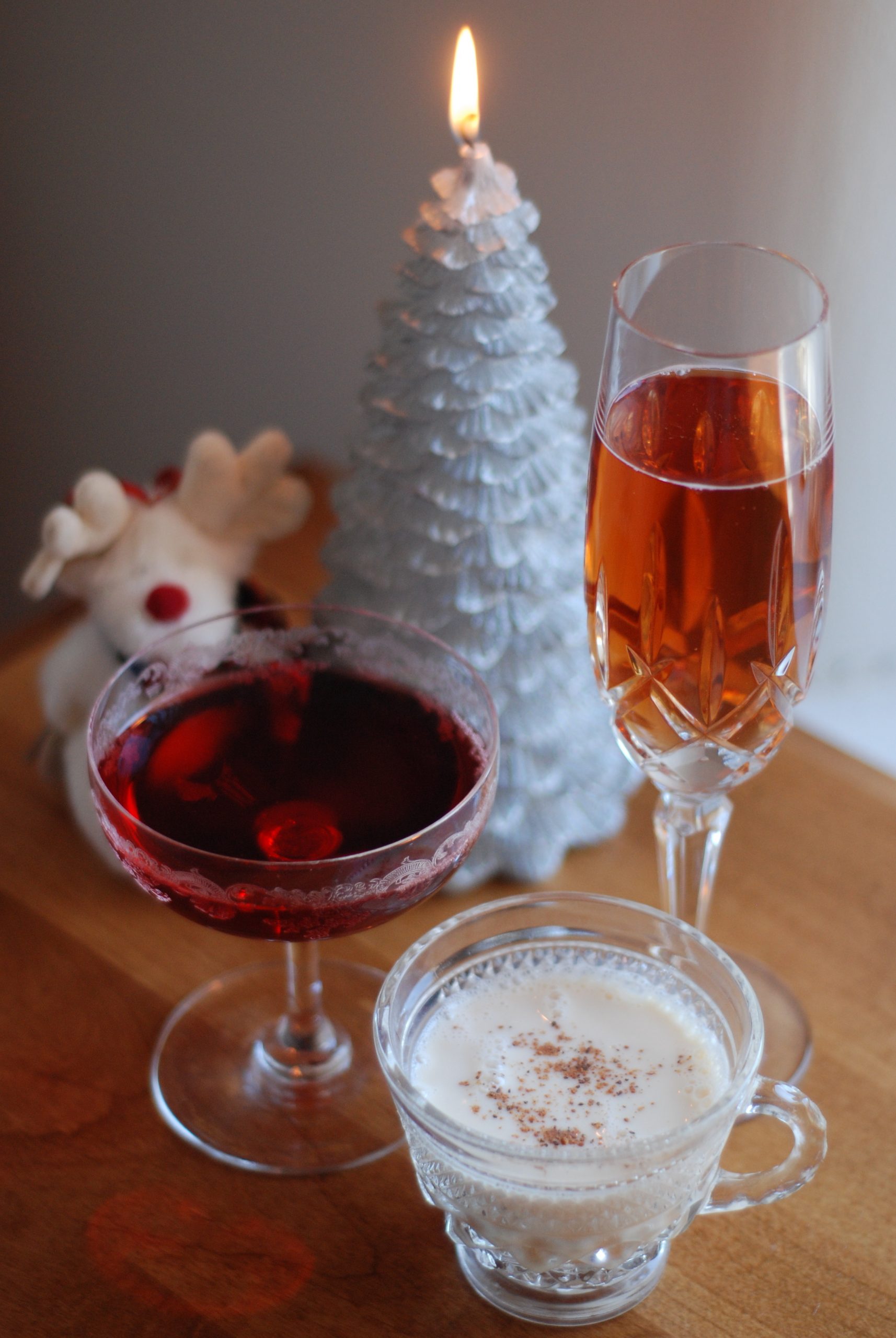
Maybe you’re like me, an only child who grew up in a small family that quietly celebrated the holidays. On the other hand, maybe you’re like me and you have 30 friends coming over on Christmas Eve to revel in the holidays. Then again maybe you’re like me and believe that the key to any small or large holiday gathering is a wickedly good cocktail. As I mull over my drink offerings and make last minute adjustments to Friday night’s dinner menu, I thought that I’d share a few cocktail favorites. Easy and quick, they’ll add a little sparkle to any occasion. For the most part they’ll also relieve any stress associated with the holidays and/or two dozen loved ones crammed into your overheated kitchen. So . . . mix those cocktails, spread some cheer and enjoy the company of those near and dear! Happy holidays! PROSECCO POMEGRANATE FIZZ Serves 8 to 10 I love Prosecco and I love pomegranate. Hence the Prosecco Pomegranate Fizz. 1 bottle prosecco or champagne, chilled 8 ounces pomegranate juice …

Something’s Fishy

With Christmas Eve and the Italian-American “Feast of the Seven Fishes” a week away I’m in the mood to chat about fish. Truthfully, at times selecting seafood seems about as baffling as choosing a new car. There are so many questions to be answered. Should I buy farm-raised or wild? If I opt for wild-caught, is it at risk of being over-fished? If I go with farmed, how do I know which countries practice safe aquaculture techniques? And shouldn’t I be stocking up on local rather than imported seafood? Once I tease out the correct answers, I have to determine which fish possesses the greatest health benefits and fewest health risks. Add in concerns about oil-contaminated Gulf Coast catches and I’m tempted to skip cooking and order a pizza instead. Thankfully, healthful and eco-friendly seafood does exist. The wild European anchovy sits at the top of the Environmental Defense Fund’s “eco-best” seafood list. Although this small, omega-3-rich fish swims in all warm oceans, the most prized come from the Mediterranean Sea. Here the supply is …

Holiday Gifts for the Cook: Kitchen Gadgets!

If you cook, write about food or just enjoy a good meal, chances are that you own a kitchen tool or two. If you fall into all three categories, then you may be like me — swamped with cooking gadgets. Over the years I’ve compiled a mental list of what’s fun, what’s functional and what’s foolish for the home cook. Below are some of the best that I’ve collected. Relatively inexpensive and easy to find, they’re bound to delight you and/or the food lovers in your life. I love a little kitsch in the kitchen. Hence my delight over these quirky kitchen timers. Functional and fun, no one will mind owning more than one. Along with lady bugs and cats, chickens, cows, frogs, dogs, ducks and portly chefs all can keep track of your cooking times. How could you not enjoy cooking with these cheerful guys taking care of your casserole count down? I can’t help it — graters are great! Although you truly only need one all-purpose, hand-held grater, I’ve ended up with five. …

The Perfect Holiday Gift? Edible Treats!

Sometimes it feels as though I’ve spent a lifetime rooting around jam-packed stores, searching for, but never finding, the perfect holiday gift. That’s why I’ve started giving edible presents. Who can resist a basket filled with tea, coffee, candies, cakes and breads or bottles of local wine, liqueurs and infused oils? In my case, no one. Whether homemade or store-bought, gourmet edibles satisfy everyone on my shopping list. Giving food is not a novel idea. During the Viking Age the Norse god Odin traveled across the cold winter landscape with his reindeer to deliver fruit and corn. Centuries later Saint Nicholas took over Odin’s route and filled European children’s shoes with sweets. In Colonial times old Saint Nick brought American youth cakes and fruits while they in turn left out hay and carrots for his faithful white horse. As a little girl, I often heard tales of how my uncle and mother would bound down the stairs on Christmas morning to find their stockings bulging with oranges, whole walnuts and penny candy. The oranges were …

Talkin’ Sides for Turkey Day

Since virtually every food writer in America is talking about Thanksgiving this week, I’ve decided to jump on the bandwagon and share a bit about turkey day. As you’ll see, the history lesson is short. The recipes, however, are plentiful. As most may know, Thanksgiving didn’t become a national holiday until President Lincoln declared it so in 1863. Even so, early 19th century Americans still gave thanks for successful harvests and other welcomed events with sumptuous meals. These celebrations featured an array of meats such as pork, venison, duck, goose, chicken and turkey. They also included sweets such as dried fruit, plum puddings, fruit pies and tarts. Missing, though, were many of the delicious side dishes that I so enjoy. While these dinners lacked my garlic-chestnut Brussels sprouts and three cranberry conserve, they offered something that the present holiday doesn’t – a strong religious tone. This was particularly the case in New England where colonists spent their days of thanks in church rather than at the table. By the late 19th century the religious aspect …

Salty Like the Sea

One of the essential minerals and oldest seasonings has gone gourmet. Forget about the white, fine-grain, mass-produced salt crystals of the past. Chunky sea salts in hues of beige, pink, red and black have taken over kitchens, tabletops and gourmet grocery aisles around the globe. Prized by chefs, connoisseurs and home cooks, they come from France and the Mediterranean coast, from salt pans in Tunisia and Majorca and from countless other sites, including Hawaii, Australia and Bali. In the Mediterranean sea salt is produced by an age-old technique. Here sea water is collected in shallow basins and allowed to evaporate in the sun. As it dries up, salt forms at the base of the pans. There it takes on the color of the clay or other natural materials found on the bottom. The salt at the top remains pure white. In France this delicate salt is known as fleur de sel. Light tasting and quick dissolving, it’s primarily used to finish dishes but it occasionally appears in baked goods. What do cooks do with all …

“A” Is for . . .

With World Go Vegan Week right around the corner I’ve been thinking quite a bit about animal-free meals. Since my household abhors tofu and seitan, the obvious vegan players are out of the picture for now. Instead I’ll be reaching for such protein-rich foods as beans, lentils and avocados. Native to Central and South America, the creamy, pear-shaped avocado has been cultivated for over 7,000 years. In spite of its long history and popularity the avocado didn’t pop up in North American kitchens until the late 1800’s. Europeans had to wait even longer, until the early 20th century, to enjoy this rich, luscious fruit. All avocados descend from three original types – Mexican, Guatemalan or West Indian. While there are now over 500 varieties, I usually look for a Hass. California’s main avocado crop, Hass possesses an oval shape and pebbly, greenish-black skin that peels easily. It’s in season from early winter to summer. In general, though, avocados are available year-round. Rich in fiber, potassium, protein and “good fats,” the avocado is most often consumed …

Pretty as a Persimmon

Sometimes we start off on the wrong foot with food. Such was the case with my husband and the pretty, leaf-topped persimmon. One bite of a firm, unripe persimmon and Sean swore never to touch this fall fruit again. Why such a negative reaction? Unless it’s ripe, this small, plump orb tastes as bitter as a harsh astringent. Persimmons peak in mid-October. By that point they’ve turned a beautiful brilliant orange and taken on a soft texture and honey-apricot flavor. Any picked and eaten before then run the risk of tasting tinny and, in Sean’s case, terrible. Early settlers learned this invaluable lesson about ripeness from Native Americans. They allowed the fruit to ripen fully and fall from the tree before consuming it. Even with this good example some colonists found out the hard way about young persimmons. In the 17th century Captain John Smith noted that ‘if it be not ripe it will draw a mans mouth awrie with much torment . …” Boy, does that sound familiar! A good persimmon requires only a …